Gunning for gunnera
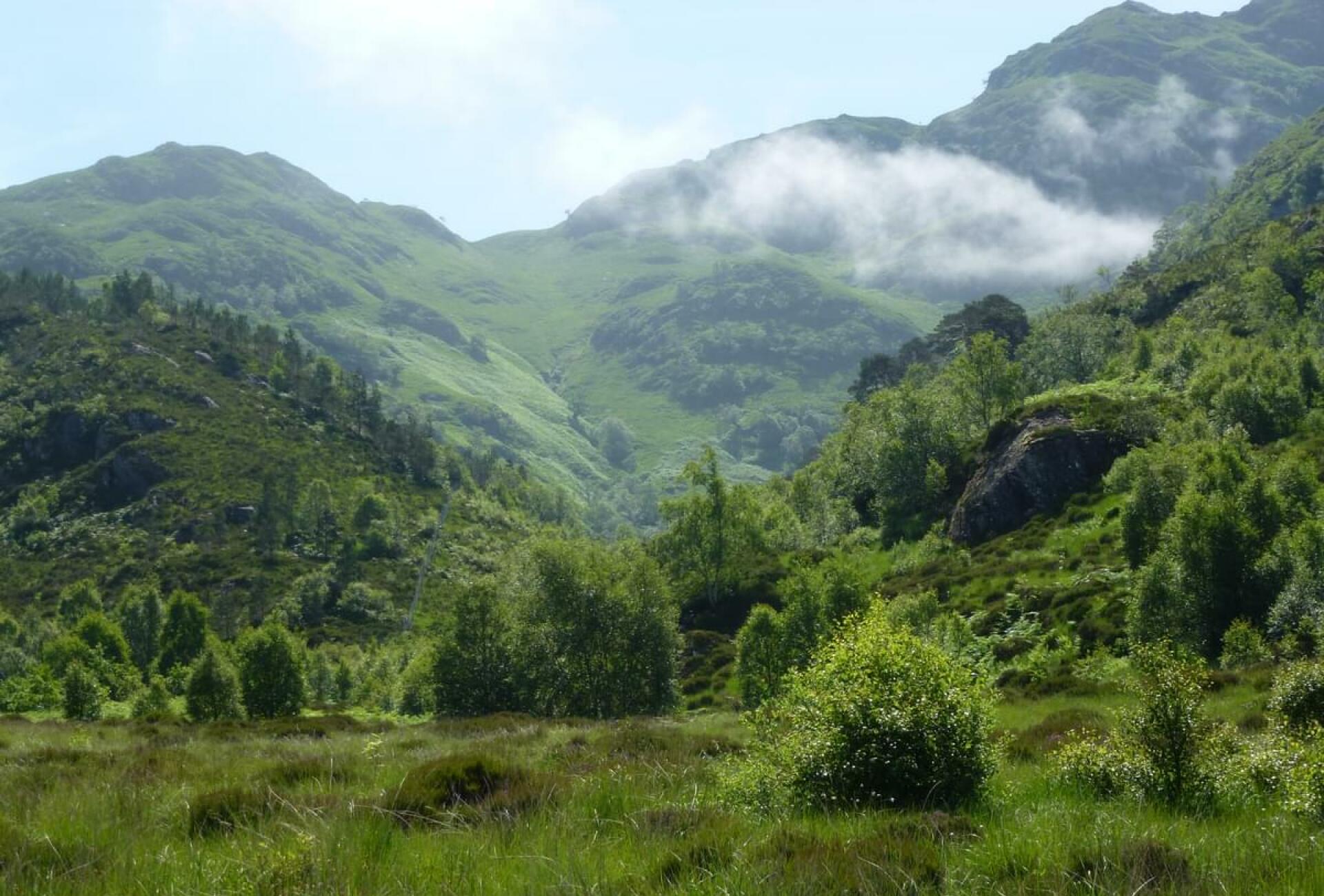
Communications Officer Natalia Barbour looks at ongoing efforts to tackle an invasive giant plant on Knoydart.
Anyone exploring the remote woodlands at Lì and Coire Dhorrcail on Knoydart may encounter an exotic looking plant with huge, sprawling leaves covering a stretch of hillside and nearby burns.
This is gunnera, a giant, Jurassic-looking plant that is climbing steadily up the hill, towering over other vegetation. It’s a striking sight, but the problem is that it doesn’t belong here.
More commonly known as giant rhubarb, gunnera is not native to Knoydart or even to the UK. It is not even related to true rhubarb. With enormous leaves – sometimes two metres across – and thick stalks, the plant’s name comes from its resemblance to the much smaller rhubarb that we know well.
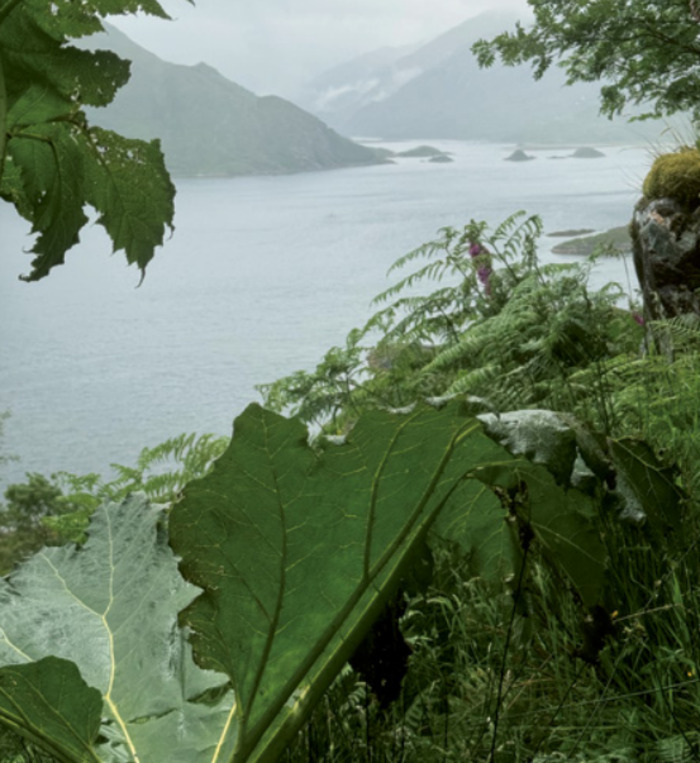
Gunnera is believed to have been originally transported to the UK by the Victorians for use in their glasshouses. For a long time, most of the plants in the UK were believed to be Gunnera manicata, a species native to Brazil. However, by examining the plants’ DNA, the Royal Horticultural Society recently discovered that most gunnera plants in the UK are actually a hybrid between Gunnera manicata and the highly invasive Gunnera tinctoria, which originates from the wetlands of Argentina and Chile.
This hybrid is named Gunnera x cryptica in reference to its cryptic existence, having hidden in plain sight for years.
Across its home range in South America, G. tinctoria populations are kept in balance by natural controls, but those controls don’t exist in the UK, leaving the plant free to spread at a remarkable rate. Given its invasive nature, the sale, cultivation and release into the wild of both G. tinctoria and G. x cryptica is now banned in the UK.
Ideal conditions
One of the secrets of the spread of gunnera is that it produces thousands of tiny seeds, which can easily be transported by birds, wind and watercourses, helping the plant to populate areas far away.
Gunnera can also spread through broken plant fragments, including sections of rhizome – plant stems that grow underground and from which roots can establish. This makes removal more challenging, as any remaining fragments underground are highly resilient and may allow plants to grow back.
We believe Knoydart’s gunnera may have first been planted in a private garden and then spread by wind, water or birds until it took hold along watercourses halfway up the hillside. While its distribution is reasonably contained at present, gunnera poses a significant threat to the riparian habitat and stability of the banks of the burn as native species are shaded out.
Taking action
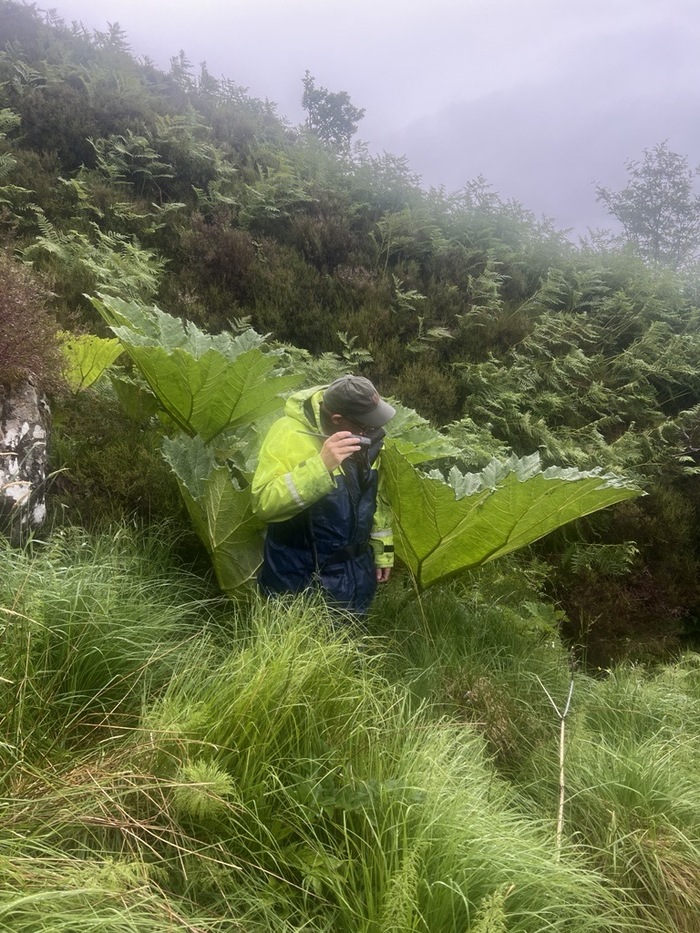
In an area such as Knoydart, which is sufficiently remote to make regular and ongoing population control challenging, complete removal of the plant is the only reliable way to protect native species and habitats.
However, the remoteness of the area is such that traditional methods used to remove invasive species need to be reconsidered. The easiest way to reach the gunnera at Lì and Coire Dhorrcail is first by boat, travelling across Loch Hourn, and then by foot, trekking up the steep hillside and battling thick vegetation and midges along the way.
The most realistic approach is likely to be stem treatment, which involves injecting a herbicide such as glyphosate into the plant’s root system. Typically, stems are injected early in the season and over a number of years the plants break down and die in-situ. With the plants having to be targeted one by one, this method does require a high number of injections, with at least 90% of a gunnera patch needing to be injected to achieve successful eradication.
Although not immediate, stem treatment is the most practical and reliable way to clear the gunnera and offers the best chance of long-term removal with minimal disturbance to the surrounding environment. The Trust is currently scoping fundraising for this work, which will form a key part of our land management planning over the coming years.
- This article first appeared in the Autumn 2025 edition of the John Muir Trust Members' Journal. If you would like to receive our Journal twice a year please consider joining the Trust as a Member.