43rd Annual General Meeting
Members gathered in the Scottish Borders for the John Muir Trust’s 43rd Annual General Meeting (AGM), reflecting on a year of progress for wild places and hearing about the opportunities and challenges ahead.
Members joined the Trust at Cardrona, near Peebles, in late September for the AGM, following a day of exploration and connection at the Trust’s 2026 Members’ Gathering at nearby Glenlude. The gathering offered an opportunity to experience the Trust’s volunteer and restoration hub; get a first-look at preparations for the new Gathering Shelter; meet fellow Members and see some of the work being undertaken to restore nature first-hand.
The following morning, Members came together at the Trust’s AGM to hear about progress in 2025 and plans to strengthen wild place protection across the country.
Reflecting on a year of progress
Trustee Steve Carver welcomed Members to the AGM and explained that he would be acting as Chair during the AGM, supported by fellow Trustee, David Rogers. Jane Smallman had stepped down as Chair the previous week. Steve added that the Board of Trustees would be electing a new Chair soon after the AGM.
In his report, Steve reflected on a year of encouraging progress for the Trust, while acknowledging the increasingly complex challenges involved in protecting wild places.
A significant milestone in 2025 reported was the Board’s formal agreement on the definition of wild places as “land where natural processes and natural landscapes take primacy through the way the land is managed”. This provides an important foundation for the Trust’s ongoing development of the Wild Place Quality Index – a tool that will help measure wild place quality, inform land management decisions and help ensure charitable funds are used effectively.
Steve also highlighted encouraging signs of native woodland regeneration, through sustained efforts to reduce deer densities. Other highlights covered included: celebrating 25 years of caring for Ben Nevis along with our volunteers and partners at Nevis Landscape Partnership; our Glenlude partnership with Phoenix Futures winning a Nature of Scotland Health and Wellbeing Award; the successful launch of our redesigned John Muir Award, helping more people connect with and care for wild places; among others.
Reflecting on these achievements, Steve emphasisied what can be achieved through the dedication of our staff, Members and volunteers, strong partnerships and a shared commitment to protecting wild places.
- Read more highlights in our 2025 Annual Report.
A clearer vision for protecting wild places
CEO David Balharry then outlined progress towards developing a Wild Place Quality Index (WPQI); building on the Board’s agreed definition of wild places. David outlined three priorities: defining, mapping and measuring wild places.
David acknowledged that people's relationships with wild places are deeply personal and different landscapes hold meaning for different people. However, he pointed out that protecting wild places effectively requires more than personal interpretation. It requires a clear, consistent and evidence-led approach.
By establishing a shared definition, identifying land where natural processes take priority, and measuring the quality of those landscapes over time, the Trust aims to develop a stronger evidence base for its work. The proposed Index will help inform land management decisions, measure restoration progress and support collaboration with other landowners and conservation partners.
David illustrated the opportunities and complexities involved, drawing on examples from Skye, Schiehallion and Knoydart. These highlighted both encouraging signs of ecological recovery and the continuing pressures from grazing, invasive non-native species and historic land management. He also shared examples of native woodland regeneration at Knoydart, where young birch trees are beginning to recover, while acknowledging that progress remains uneven and further work is needed.
The ambition is to build an approach that strengthens the Trust's management of land in its care, and also helps advance wild place protection more widely.
Finance report
Trustee and Convenor of the Finance Committee Carol Whilte, supported by Director of Finance and Resources Rob Buckman, presented the Trust’s Financial Report.
Carol reported that financial management at the Trust is now well established, with the Trust’s income in 2025 remained broadly consistent to the previous year – driven in large part by generous legacy income, while expenditure came in under budget.
Although the Trust’s financial position has strengthened, Rob emphasised the importance of cautious planning, particularly given the unpredictable nature of legacy income and the wider financial pressures facing the charity sector.
To improve support long-term financial resilience, the Trust has established two new designated funds: the designated financial resilience reserve; and the investment reserve – a safety cushion that also adds to income each year. Together, these are intended to provide greater financial stability and help ensure the Trust can continue delivering its mission in the years ahead.
- Read more detail in the 2025 Finance Report.
Welcoming our Trustees
David Rogers, Douglas MacMillan, Heather Alexander and Peter Barron were welcomed as newly-elected Trustees. The Board also agreed to re-co-opt Graeme Fisher.
- Find out more about our Board of Trustees.
Looking ahead
The AGM concluded with an open Q&A session, giving Members an opportunity to raise questions with the Board and Leadership Team.
Discussions covered a range of topics including: governance and transparency; senior leadership costs; staffing and local engagement on the Trust’s properties; financial sustainability and income generation. Members also raised questions about organisational culture, the redesigned John Muir Award and the Trust’s longer-term approach to protecting wild places.
The Board and Leadership team responded to the issues raised and outlined work underway in several areas, including strengthening financial reporting, reviewing income generation, improving staff policies and engagement, and developing the Trust’s approach to land management and partnerships.
The discussion highlighted the importance of open dialogue with Members and the need to continue these conversations as the Trust looks ahead.
Thank you to everyone who joined us in the Scottish Borders, and to all our Members, volunteers and supporters whose continued commitment helps protect wild places for generations to come.
- Read a summary of the full Q&A, including outstanding questions from the previous year’s AGM.
- Feedback on the 2026 AGM and what you'd like to see at the 2027 AGM.

Related News
21 Oct 2026
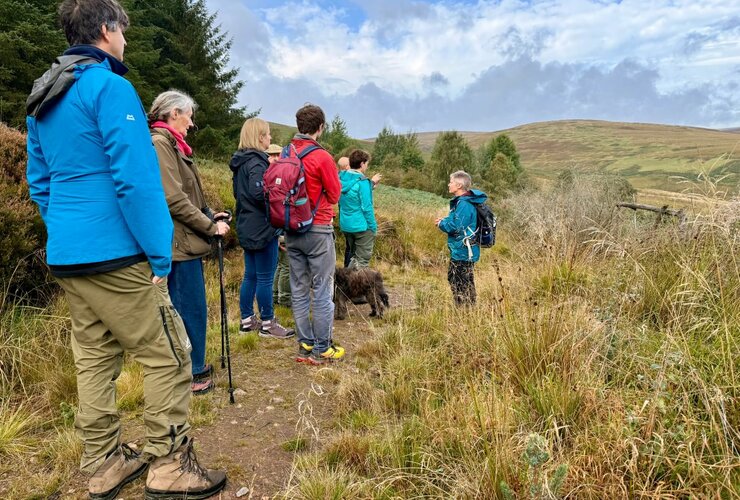
Members gather and discover nature’s recovery at Glenlude
20 Oct 2026
On the right track