When woodland returns to Quinag
As the Trust celebrates over 21 years of caring for Quinag, the Trust’s Head of Wild Places Index Matthew Coathup reflects on the progress made and what the future may hold for this special place.
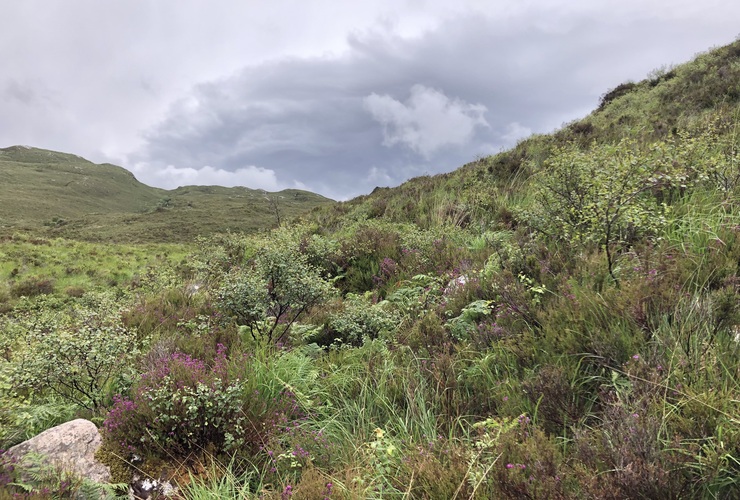
It’s early April as I drive north through Assynt. Spring comes late here, but clear blue skies and vibrant green leaves, just starting to unfurl, reassure me that winter has passed. I’m almost at Quinag, a mountain at the heart of a 3,700ha estate that the Trust has cared for since 2005.
Quinag is a broad, imposing fortress in the landscape. It is bound to the south by the lonely expanse of Loch Assynt, where the crumbling outpost of Ardvreck Castle perches on a small promontory overlooking its dark waters.
Unable to resist a quick detour, I park in a roadside layby, pull on a jacket and walk towards the castle along a narrow, sandy causeway. Built in the 15th century by the Macleods of Assynt, the castle is a commanding sight even in its ruined state. Drawing the eye, it fills the imagination with thoughts of the people who set foot within its once robust walls. Standing between its now roofless walls, the weight of history feels almost overwhelming.
This rich human story – of lives lived, of struggle, kinship and belonging – is deeply woven into this landscape, shaping the names on the map. And yet, it rests within an unfathomably vast and ancient land that has been reforged time and again in fire, rock and ice.
Looming all around, the Quinag complex is made primarily of Torridonian sandstone sitting atop a platform of Lewisian gneiss and cut by younger dykes of igneous rock. At up to three billion years old, Lewisian gneiss is considered one of the oldest rocks in the world, while the sedimentary Torridonian sandstone is a mere one billion years old.
Assynt’s landscape is very different from elsewhere in Scotland, in large part thanks to its position on the Moine Thrust – a fault line along which tectonic forces smashed huge strata of rock over one another. Ice ages and millennia of erosion then scraped away the softer rock at the surface, leaving steep towers of sandstone topped by Cambrian quartzite. The thrusting, isolated peaks of Assynt are what remain today.
Finding woodland
Back in the car now, the road splits shortly after Ardvreck and I head due north. Here, the fortress really comes into view. Like many of Assynt’s great mountains – Suilven, Stac Pollaidh, Canisp and others – towering walls of rock erupt from the surrounding, lochan-filled landscape, giving rise to imperious cliffs, jagged turrets and airy ridges.
Quinag is broader and more complex than some of its neighbours. A range of three Corbetts rising to 808m at its highest point and linked by an undulating Y-shaped ridge, its name is an anglicisation of Cuinneag, meaning milk pail, reflecting its broad, steep shape and uneven, rounded tops.
Each point on the Y – Spidean Coinich (Mossy Peak) to the south and the two to the north, Sàil Ghorm (Blue Heel) and Sàil Gharbh (Rough Heel) – forms a formidable buttress in its own right.
There is an inescapable feeling of wildness here, and I find that walking into the heart of the massif feels like stepping into another world. But that’s not where I’m heading today. Instead, I drive along Quinag’s eastern flank, past the Trust’s car park, and turn just south of Unapool onto a smaller road that tracks the north side of Quinag.
I pull over after a couple of kilometres, just before a small bridge. Unlike the exposed rock, heath and bog found elsewhere at Quinag, here there is a patchy covering of remnant woodland, now successfully regenerating under the Trust’s stewardship.
This is part of the Ardvar Woodlands, a Site of Special Scientific Interest and European Special Area of Conservation which forms some of the most northerly fragments of Scotland’s temperate rainforest. The woodland here is dominated by birch but is also home to hazel, holly, aspen, alder, willow and rowan.
Today, Ardvar and the land extending north from here to the Trust’s lodges at Kylesku is the most densely wooded area at Quinag. But it isn’t the only place where trees can be found. Gnarled remnants hang onto crags and on the banks of steep burns and ravines throughout much of the Trust’s estate.
These woodlands are of enormous biodiversity value. High humidity, a coastal climate and the geology and topography of the land produce a special environment. In total, 431 species of higher plants have been recorded at Quinag, as well as nationally significant assemblages of bryophytes (mosses and liverworts) and lichens.
Dwindling cover
However, many of the habitats, especially woodland, on and around Quinag have declined or disappeared. Ecological records show evidence of species now rare or absent, including oak, aspen, juniper and wych elm.
Gaelic place names also point to a more wooded history – Alttan na Salàch, Wee Burn of the Willow; Bad na Fearaig, Place of the Alder; and Doire Cuillin, Holly Grove.
John Home’s Survey of Assynt maps, 1774, show more widespread tree cover than is found today. A century later, first edition Ordnance Survey maps show less tree cover, but still more than exists today. This is the case across much of Scotland, with the latest National Woodland Survey of Scotland estimating that native woodland now covers just 4% of the country’s land area.
While climatic factors may have played a role in this dwindling native tree cover, the decline has been primarily human driven, from large-scale woodland clearances and agricultural expansion, burning to maintain open ground and intensifying grazing pressure from livestock and deer.
Over recent centuries, deer numbers have increased dramatically in Scotland. Initially, this was driven by the loss of apex predators such as wolves, which were hunted to extinction here in the 18th century.
But over the last 150 years this population rise has been inflated by land management practices, especially on sporting estates which often actively encourage high deer numbers. The population in Scotland continues to grow and is estimated to have doubled from 500,000 in 1990 to around one million animals today.
At sustainable densities, deer are a crucial component of Scotland’s environment. But in such numbers, their heavy browsing suppresses regeneration and now represents the single greatest threat to native woodland recovery.
Signs of life
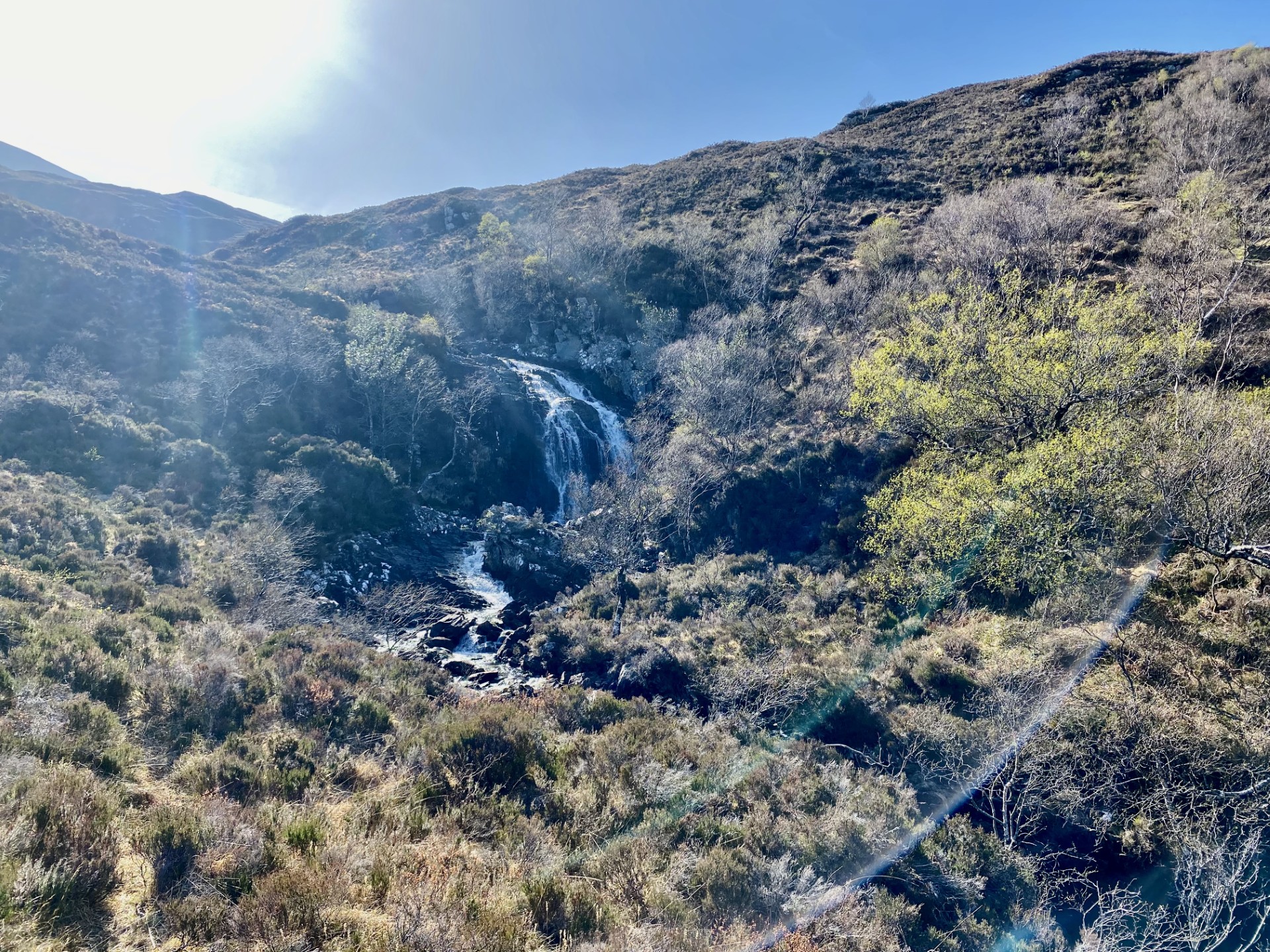
I locate a faint track heading south and set off, climbing gradually along the Allt a’ Ghamhna right on the boundary of Trust ground. Quickly, I reach one of my favourite places at Quinag: an area of flat ground before a sparkling waterfall that emerges from the hillside, bathed in hazy, golden rays. The only sounds are the gush of water, the rhythmic hum of insects and the piercing cry of a golden eagle as it flies overhead.
I’m surrounded by trees, their delicate leaves just emerging. Although still close to the road, this place feels wild, hidden and alive. Looking more closely, there are signs that it isn’t just a feeling – this place really is coming back to life. At my feet, there is lush heather while, all around, young birch trees, some now a metre high, reach for the sky.
I walk slowly south-east, following the edges of existing birch woodland, hunched low to the ground, looking for more signs. It’s not long before I spot them: tiny seedlings, just a few centimetres high, not just birch but rowan and holly too.
In recent years, the Trust has doubled its annual deer cull at Quinag. In the absence of natural predators, it is the only humane way to manage deer populations, and the most important means of helping restore conditions to a state which gives natural processes a chance to thrive.
Across much of the Quinag estate, where remnant trees once held onto only inaccessible crags and ravines away from hungry mouths, young trees are now beginning to grow, especially along the south side of the range.
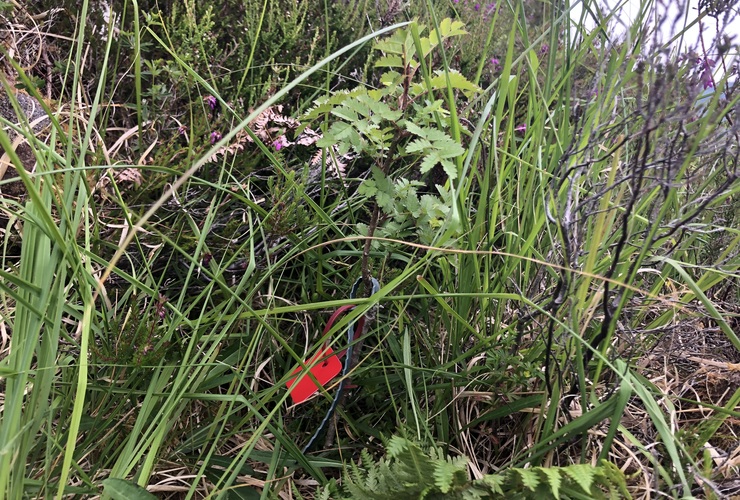
The data backs this up. The Trust conducts annual monitoring of around 100 tagged young trees at Quinag, distributed around the woodlands to the north as well as the south of the estate. Deer culls have been increased in the three years from 2022 to 2025 and, in that time, average marked seedling height, which had previously remained static, increased from around 49cm to 64cm.
The percentage of marked trees with their leader shoot browsed (at point of measurement in late spring each year) has dropped from around 60% to 32%. There are similar trends when the data is analysed across different monitoring zones, demonstrating steady and widespread regeneration. After centuries of decline and slumber, nature really is beginning to wake up.
Natural regeneration
The Trust advocates for the restoration of natural processes and giving nature the freedom to shape landscapes. For this reason, we typically promote natural regeneration in our wildest places, rather than using measures such as tree planting.
Nature is dynamic, and natural processes are complex, so rather than trying to say exactly where there should be trees and how many, we aim as far as possible to restore conditions that allow nature to decide. But this is a slow process and management of deer densities will need to be maintained for years to come.
Pausing for a moment, I allow myself to imagine returning in 20 years from now and seeing a wild place flourishing as it grows into a thriving natural landscape. There will be greater tree cover as part of a balanced natural system. Open, rocky ground will remain but with thicker and more diverse heath, where heather is not supressed and cropped by overgrazing. At higher altitudes, perhaps there will even be healthy montane scrub, with dwarf birch, willows and juniper.
In this scenario, deer will remain an important part of the ecosystem, and the Trust is also interested in other important, but currently missing, native species that would scarify the land, creating a seedbed for tree seeds to germinate. For instance, we are looking to explore native cattle with no-fence collars to fulfil that role in the future.
Heading back to the car, I reflect on how as a charity for wild places our responsibility is to advocate for, protect and restore corners of the world where nature can lead the way. This is especially important now given the scale of threats facing nature, wild places and humanity.
I also think about the countless human stories that have seen names given to maps. The challenge is to find ways to strike a balance between the two; humanity needs wild places, both for their intrinsic value and also for the vital services that thriving natural processes and landscapes provide us.
The Trust has a vital role to play and the ongoing regeneration here is a sign of the positive impact that we can continue to have. I leave Quinag as I began the day – a little overwhelmed by the weight of history but also full of hope for its future.
- Find out more about our work at Quinag.
- This article first appeared in the Spring / Summer 2026 edition of the John Muir Trust Members' Journal. If you would like to receive our Journal twice a year please consider joining the Trust as a Member.
Help us care for wild places in 2026
Support our vital work to protect wild places like Quinag
Related News
28 Sep 2026
A grand day out at Glenlude
14 Sep 2026
Work starts on Glenlude's gathering shelter