Beyond the boundary on Schiehallion
In autumn 2025 members and supporters responded generously to our Mountain Woodland Appeal. Here we explain how those donations will help the recovery of a rare mountain habitat at East Schiehallion, as part of a bigger ecological story.
Every landscape is shaped by forces of nature and humans, and the question for land managers is which forces should be allowed to prevail.
On East Schiehallion, centuries of land management choices have had a profound influence on the mountain’s ecology. Through overgrazing from sheep and red deer, woodland has retreated, montane scrub clings on in only a few areas, and the natural progression of woodland from the lower slopes of the hill to its summit hasn’t been seen for generations.
The Trust believes that natural processes should be given primacy and grazing pressures reduced to allow natural regeneration of montane woodland in the areas where it seeks to grow. Over grazing is one of the most important challenges facing our wild places.
Over the coming months, the Trust will begin the repair and installation of boundary fencing across part of East Schiehallion. The construction of stock fences to keep wandering sheep off the ground has generated some public discussion and, working with Scottish Woodlands, the Trust has considered those conversations throughout the planning stages.
The fence is the latest progress in a long-term programme of ecological recovery at East Schiehallion. In 2017 the Trust launched the Heart of Scotland Forest Partnership, to connect woodlands across more than 3,000 hectares. Part of that work with our partners and neighbours at Dùn Coillich - owned by Highland Perthshire Communities Land Trust - has transformed the lower slopes of East Schiehallion by allowing ecological succession with young Scots pine, birch and rowan. The Trust is now seeking to prioritise natural processes at a larger scale.
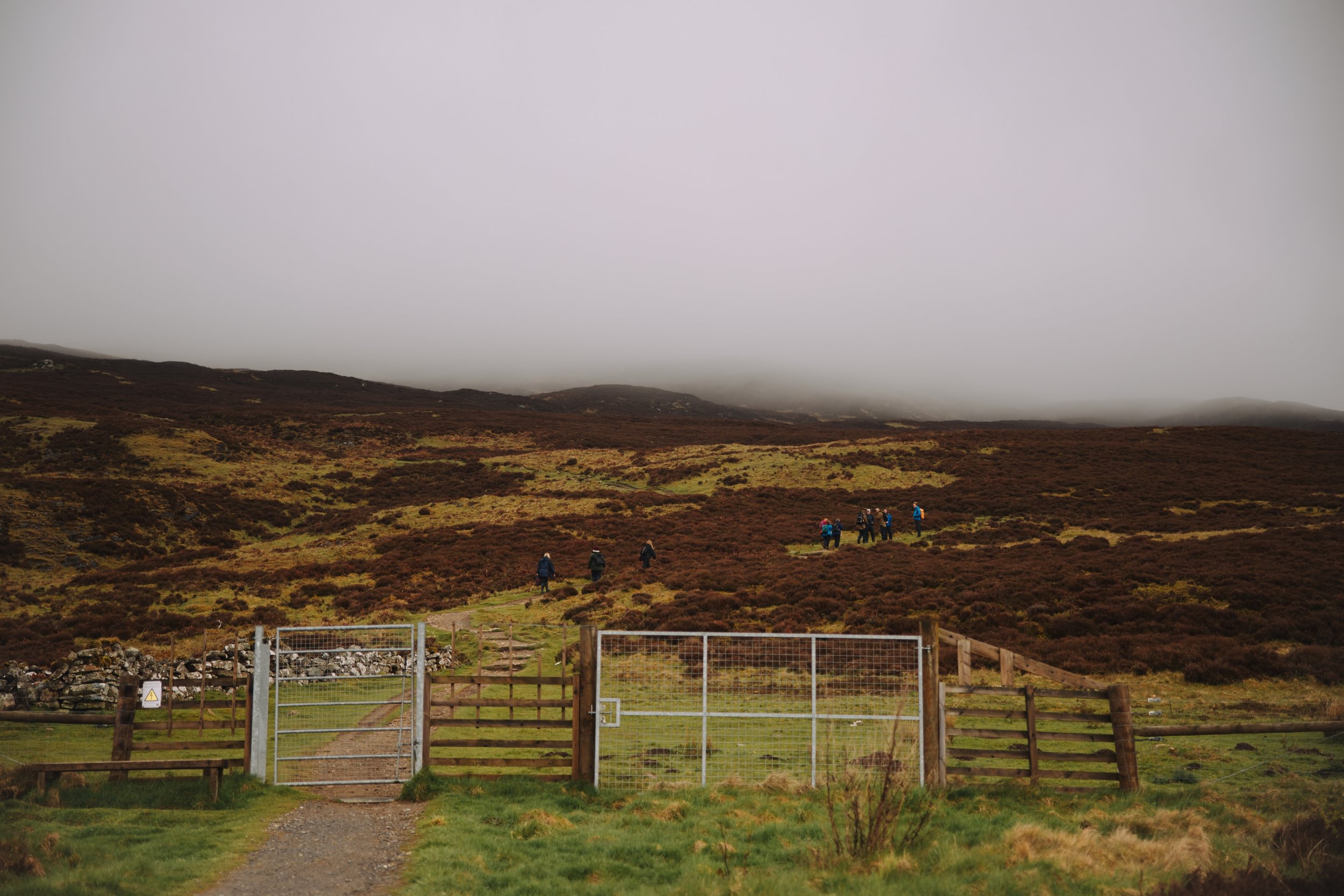
While stock fences are a familiar feature on Schiehallion, and fences are used by many landowners in Scotland to protect regenerating young trees, installing fences are a last resort for the Trust.
David Balharry, CEO, said: “Putting in a fence for us is sub-optimal given one of our strategic pillars is to protect natural landscapes. Having fences inside our properties is even less ideal. Our gains here are losing an internal fence, while installing a boundary fence and perhaps most importantly allowing natural process to function freely and montane woodland to recover.”
This acknowledgment is important. The Trust is not presenting the fence as an ideal outcome, neither is it suggesting there are no trade-offs. Rather, it reflects the practical challenges of restoring ecological integrity to a natural landscape over the longer term.
As David puts it: “The grazing pressures that we have, both from domestic livestock and high deer numbers, mean our habitats aren't recovering. So, by reducing or being able to manage the grazing pressure, we can create an extraordinary benefit for ecology.”
A different view
For most people, East Schiehallion is defined by its cone-shaped summit which makes the mountain one of Scotland’s most recognisable and popular Munros.
East Schiehallion lies within the Loch Rannoch and Glen Lyon National Scenic Area and is a designated Site of Special Scientific Interest (SSSI) for its geology and limestone influenced habitats. The walk from Braes of Foss car park to the summit passes through a sequence of habitats. Lower slopes capable of supporting native woodland give way to scattered montane scrub.
Few places in the UK contain such a continuous ecological transition. Today, however, those habitats no longer connect as they should. Rare montane willow survives mainly in steep gullies and rocky crags beyond the reach of herbivores, which means the transition between woodland and open mountain cannot establish. Understanding that fragmentation and the impact of grazing on the development of the montane woodland explains why the Trust believes intervention is necessary.
Over the fence
The Trust’s long-term vision is to protect natural landscapes and natural processes rather than using species-specific conservation measures.
David explained: “What the Trust is trying to achieve is a network of places where the landscapes and the ecological processes are as natural and wild as they can be, given the geographic and social context.”
That distinction matters. Where those processes are functioning, woodland regenerates and montane scrub ecoystems recover with minimal human direction.
Scotland’s landscapes have been influenced by people for centuries and they contain human-made features of rich cultural significance. Sheep farming at scale arrived in the Highlands following the clearances. East Schiehallion currently has open borders to the west and large numbers of sheep often enjoy access to Trust land. It is the access of these livestock that the Trust seeks to restrict.
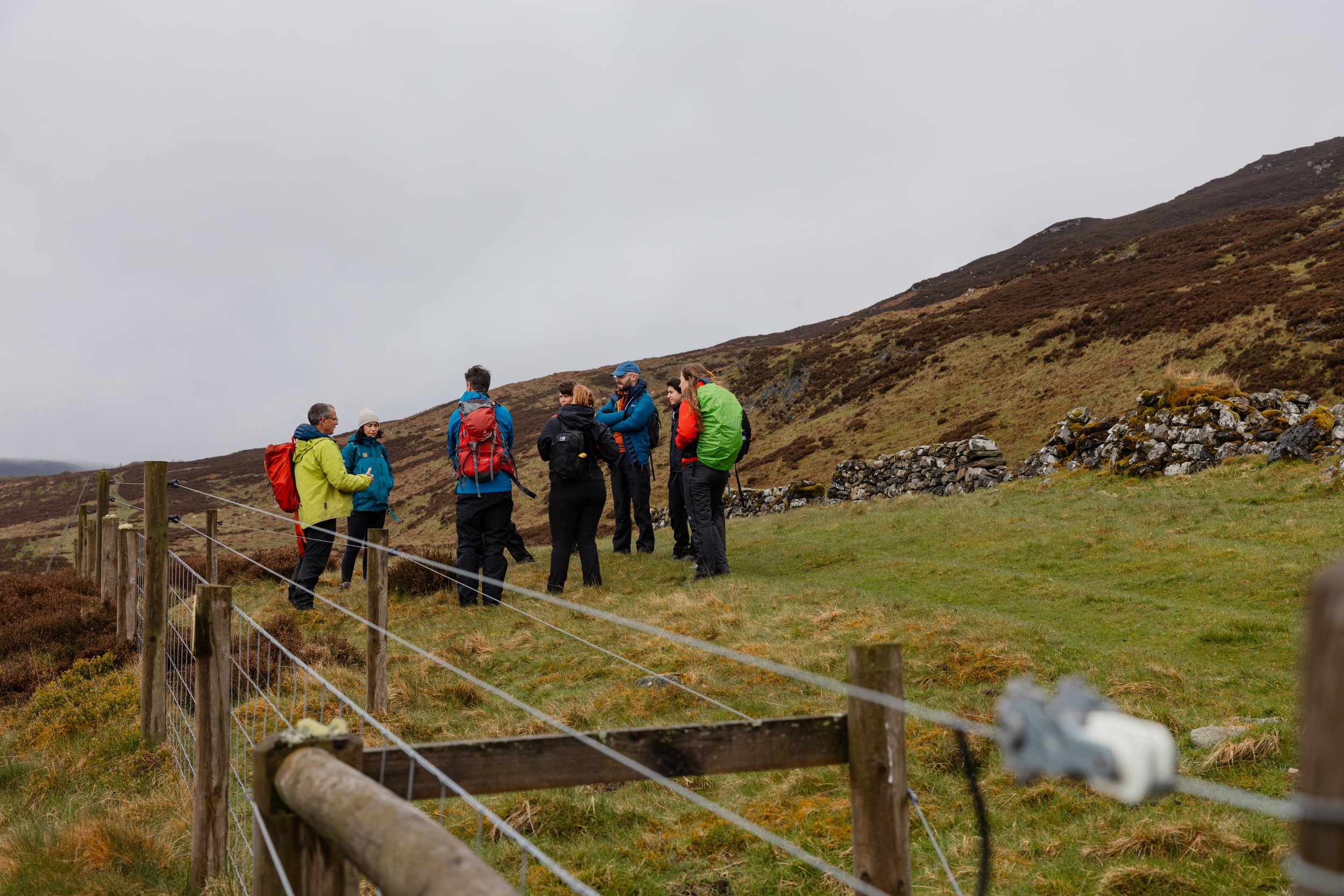
Deer populations on surrounding land also exist at densities that prevent woodland recovery and the stock fence being constructed to exclude sheep has an electrified offset wire to restrict deer access without the visual intrusion of a deer fence.
Phase one of the fencing project is focused along the northern boundary. Much of that work replaces an ageing stock fence with an additional 200 metres of new fencing being added to close a gap between the termination of the old fence and the boulder scree that runs up to the ridge line.
Some sections, particularly where the fence climbs the open hillside, will be more apparent than others and the impact will be mitigated by following existing landforms and boundaries wherever possible.
Evidence led
Neil White, Regional Manager Central-East with Scottish Woodlands, who is managing the fencing installation project with the Trust, said: “One of the encouraging things is that we’ve already seen what happens when grazing pressure is reduced. The woodland responds. That’s given us confidence that extending those conditions across a much larger area can deliver much greater ecological benefits.”
David described the existing fenced areas where willow is regenerating as only the beginning. “What we’ve got currently is a postage stamp. It’s too small to provide ecological functionality for a lot of the species that might depend on it. What we’re doing now, increases the scale of the existing area by at least tenfold.”
One of the most distinctive characteristics of East Schiehallion sequential habitat change with altitude. People who walk to the top of Schiehallion can experience 'alpine' conditions that more closely mirror the 'arctic' tundra.

Many of the key elements remain in the mountain and indicate that in the right conditions they will prosper. Rare willows including the downy and whortle-leaved willow represent remnants of a habitat that was once far more extensive.
As David explained: “We’re trying to allow the natural transition from trees to montane scrub and into arctic alpine habitats. The fence won’t simply contour around the mountain because that would create hard edges for habitats, leaving straight lines in natural landscapes.”
Planning with the landscape
By the time the first fencing materials arrive on site, more than a year of planning will already have taken place. Neil joined the project after a good deal of the initial design work had been completed. He and David walked the proposed fence line, reviewing the route on the ground, checking it would work in practice.
A competitive tender process invited 18 contractors, with an emphasis on giving local suppliers the opportunity to tender. A specialist contractor from Dunkeld was appointed, bringing extensive experience of complex upland fencing projects.
Specialist surveys for water vole and otters were commissioned and the findings helped shape the final approach. Botanical surveys were commissioned to map sensitive plant communities along the proposed fence line and ecologists walked the route to identify areas where small changes might avoid important vegetation or geological features protected by the SSSI designation.
Neil explains: “We’d already committed to carrying out pre-operational wildlife checks. NatureScot wanted those to be given greater emphasis as part of the consent process, particularly in relation to European Protected Species.”
Specialist surveys for water vole and otter were commissioned and their findings helped shape the final approach. Botanical surveys were commissioned to map sensitive plant communities along the proposed fence line and ecologists walked the route to identify areas where small changes might avoid important vegetation or geological features protected by the SSSI designation.
Perhaps one of the most exciting outcomes of the survey work came completely unexpectedly. The European Protected Species survey confirmed the presence of Eurasian beaver, the first time the species has been recorded on this part of the site. Photographs of lodges and dam-building show that beavers have established within the wider catchment.
For Neil, that discovery says something important. “I think the beaver story is a good indication of how the previous work on the site has been successful,” he said. “You’re getting species coming into the site and setting up home there that weren’t there before. That gives us confidence that this next phase of work can build on what’s already been achieved.”
It is a powerful reminder that when landscapes begin to recover, wildlife responds and sometimes in ways that were never anticipated.
Design for life
Construction will take place in three phases from late summer 2026 into 2027. Where materials need to be transported into more remote locations, helicopters will be used to reduce repeated vehicle movements across fragile ground.
Potential impacts on wildlife have also informed the design. Highly visible flight markers will be attached to sections where black grouse and other birds are considered at risk of collision.
Public access has been considered with equal care. Gates will ensure walkers can pass with ease, with their locations informed by existing paths as well as an understanding of how people move across the landscape. Neil sees this as an important part of the project’s design. “The objective is to manage grazing in a way that allows the ecology to recover while ensuring people can continue to experience the mountain.”
In the future, visitors will come to notice something different about East Schiehallion. A mountainside where woodland reaches naturally towards the open hill and where the landscape reflects the interplay of climate, geology and ecology rather than the legacy of sustained grazing pressure.
Rather than recreating an imagined past, the Trust is allowing the conditions in which natural processes can once again shape the future.
-
This article first appeared in the Autumn / Winter 2026 edition of the John Muir Trust Members' Journal. If you would like to receive our Journal twice a year please consider joining the Trust as a Member.

Related News
20 Oct 2026
On the right track
8 Oct 2026
Deer management matters